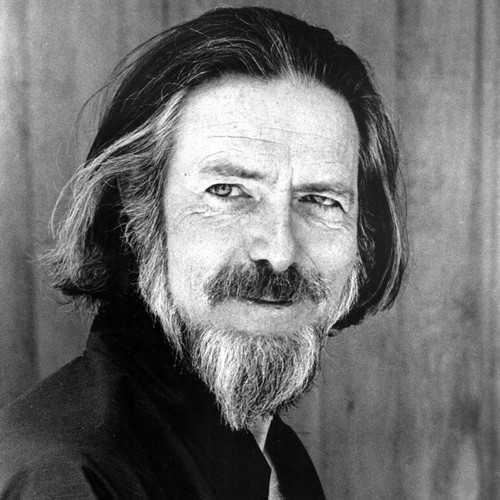
Alan Watts
1 book on FireSoul · Zen Buddhism, Taoism, Vedanta, Episcopal Christianity (ordained 1944)
Alan Watts (1915–1973) was a British philosopher and broadcaster who spent his working life translating Zen, Taoism, and Vedanta for Western audiences, first through the Buddhist Lodge in London and later through two decades of radio and television broadcasting in California. His 1957 bestseller The Way of Zen and his long-running KPFA series brought Asian philosophy to readers and listeners who had never encountered it, and David Chadwick’s interviews with early San Francisco Zen Center practitioners found Watts was the most frequently cited reason they had come to formal practice. He died in Marin County in 1973, leaving an audio archive that continues to reach new audiences through podcast and video platforms.
Books by Alan Watts
Biography
Alan Watts was a British philosopher, writer, and broadcaster whose radio voice carried Zen, Taoism, and Vedanta into the American mainstream before most Americans had heard of any of them.
He was born on January 6, 1915, in Chislehurst, Kent, a small town southeast of London. His mother worked at a boarding school nearby, and her students were mostly children of missionaries who had served in China and Japan. When those students came home, they brought things with them: painted scrolls, lacquerwork, decorative ceramics. Those objects ended up in the Watts parlor, and the young Alan didn’t just glance at them. He stared. The miniature landscapes in particular seemed to contain something the English countryside outside the window didn’t, some different relationship between figure and emptiness, between rock and water, between the mark and the paper around it. It’s a small detail, but it’s the right one to start with. He wasn’t converting to anything as an adult. He grew up inside a visual grammar that pointed somewhere, and he spent the rest of his life asking what that somewhere was.
His father brought him to the Buddhist Lodge in London, and the teenager found the intellectual world he’d been circling. Christmas Humphreys had founded the Lodge, and he became Watts’s first serious mentor. By 1932, at sixteen, Watts had written his first booklet, An Outline of Zen Buddhism, and taken on the role of secretary at the London Buddhist Association. He also edited the Lodge’s journal, The Middle Way. These weren’t amateur gestures. They were the opening moves of a working life. He spoke regularly at the Lodge during this period, and it was there that he first met D.T. Suzuki, whose scholarship on Zen would shape how the West understood the tradition for the next several decades. Those conversations, with Suzuki and with Humphreys, gave Watts a grounding in primary texts and living argument that no comparative religion course in England could have matched at the time.
He was twenty-one when The Spirit of Zen: A Way of Life, Work, and Art in the Far East appeared. Still in England, still years from any institutional role, but already a working writer on a subject the English-speaking world had barely registered. The book drew on Suzuki’s scholarship and on Watts’s own reading, and it found readers. The fact that it found a publisher at all was a small sign of the appetite that would, twenty years later, make The Way of Zen a national bestseller.
In 1938, Watts moved to New York. He lectured in bookshops and cafes, and those talks caught a publisher’s attention. The Meaning of Happiness came out in 1940, issued, as the Alan Watts Organization notes, just as the Second World War was beginning, which wasn’t ideal timing for a book on happiness. Around this period he married Eleanor, the daughter of Ruth Fuller Sasaki, one of the central figures in early American Zen. The marriage gave him a close working connection to Sokei-an Sasaki, the founding teacher of New York’s First Zen Institute and Ruth Fuller’s eventual husband. New York was serious, but it didn’t hold him. He was twenty-three, recently married, and the city couldn’t quite contain what he was after.
He enrolled at Seabury-Western Theological Seminary in Evanston, Illinois, where he dug into Christian mysticism with the same attention he’d brought to the Zen patriarchs. It wasn’t a detour. Watts had always read Meister Eckhart and the anonymous author of The Cloud of Unknowing as participants in the same inquiry as the great Chinese Chan masters, and Seabury-Western gave him the theological vocabulary to argue that case in systematic terms. He was ordained as an Episcopal priest in 1944 and became chaplain at Northwestern University, where students gathered for conversations that moved from Christian mysticism to the Upanishads to whatever was happening in depth psychology that week. He wrote three books during these years on Christian themes. But the messages from the pulpit were unorthodox, and the Church wasn’t going to hold him any better than New York had. By spring 1950, his time as a priest was over. He knew it before the Church did.
He left for a farmhouse outside Millbrook, New York, and wrote The Wisdom of Insecurity: A Message for an Age of Anxiety. It’s never gone out of print. The argument is direct and unrelenting: anxiety comes from clinging to psychological security in a world where nothing stays fixed, and the cure isn’t to find better things to cling to but to stop clinging. The logic is simple. The practice is not. Many readers still regard it as the most essential of his books, and it’s easy to see why: it’s the most compressed, the least ornamented, the one where the idea and the prose are most nearly the same thing.
In early 1951, Watts moved to San Francisco. Dr. Frederic Spiegelberg invited him to join the faculty of the American Academy of Asian Studies, and he became the institution’s director. His classes weren’t conventional academic offerings. Beat poets came. Writers came. People drifted in from the North Beach coffee houses and didn’t always drift back out again. Lectures spilled into those same coffee houses after hours. Gary Snyder was among the students in the early years. Kazemitsu Kato, a Soto Zen priest on the faculty, worked as a paid assistant to Watts while he was writing The Way of Zen, and it was Kato who later introduced Watts to Shunryu Suzuki, the Japanese priest who had recently arrived in San Francisco and would go on to found the San Francisco Zen Center. Some of Suzuki’s earliest American students came through the academy. But Watts had already left the directorship by then, and it was the last formal institutional position he ever held. He wouldn’t work for a salary at any institution again.
In 1953, he took a Saturday evening slot on KPFA in Berkeley, the listener-supported station that had launched five years earlier and had built an unusually serious audience for serious ideas. He launched “The Great Books of Asia,” walking listeners through primary texts from India, China, and Japan. In 1956, “Way Beyond the West” followed, a broader series on Eastern philosophy that broke through in the medium. What the radio gave him was his voice: unhurried, precise, capable of amusement at exactly the right moments, and free of the earnestness that made most American spiritual broadcasting of the period so difficult to revisit. People taped the programs and passed the tapes around. By the time The Way of Zen appeared in 1957 and became a national bestseller, thousands of listeners already knew how he sounded before they ever opened a book.
The television work came quickly after. In 1959, the first season of his public television program Eastern Wisdom and Modern Life aired, and a Look magazine feature visited him at home, surrounded by his children, treating him as a kind of domestic philosopher explaining the Tao to Middle America. He was the national face of Zen, whether the Zen establishment liked it or not. Much of it didn’t. He hadn’t completed a formal training period under a recognized teacher. He didn’t maintain a rigorous daily sitting practice. He drank openly and heavily. But the practitioners who came to formal Zen in the late 1950s and 1960s kept saying the same thing in interviews: they’d read or heard Watts first. In the hundreds of conversations that David Chadwick, author of Crooked Cucumber — the biography of Shunryu Suzuki — conducted with people from the early San Francisco Zen Center years, Watts was the most frequently named inspiration among those who had gone on to serious practice. Chadwick called him a pied piper who led people to be swallowed up by more formal teachers. It’s a good description. It’s also a harder role than it looks, because it requires making something genuinely difficult feel approachable without making it feel easy.
This Is It, published in 1962, collected essays on Zen and immediate experience. The title sentence names the central claim of his thought: “This — the immediate, everyday, and present experience — is IT,” he wrote, “the entire and ultimate point for the existence of a universe.” That claim is radical, even if it doesn’t sound it at first. It cuts against every system of spiritual self-improvement that offers enlightenment as a future reward for present effort. Watts wasn’t interested in improving you. He wanted you to see that the premise requiring improvement was the problem. It’s a harder sell than it appears, because most people who pick up a book about Zen do so precisely because they believe they need to change.
The Alan Watts Organization describes his philosophical method as “triangulation”: rather than advocating a single tradition, he placed multiple perspectives in relation to each other, Zen, Taoism, Vedanta, Western depth psychology, modern ecology, and argued that the comparison was itself a practice. He didn’t claim all traditions said the same thing. But he was genuinely curious about where they converged, and he thought a Western reader who understood the divergences would understand their own tradition better. The Taoist thread he called the “watercourse way”: water finds its channel without forcing; you put up a sail to catch the wind rather than pushing against the current. He also cared about upaya, skillful means, the idea that wisdom adapts its form to its audience and there’s no single correct container for insight. His twenty-plus years of broadcasting were themselves an exercise in upaya, finding the form that could carry several thousand years of Asian thought across a cultural distance measured partly in geography and partly in habit.
The relationship between Watts and the San Francisco Zen Center is one of the stranger and more instructive threads in the history of American Buddhism. Marian Derby, who worked on the initial draft of Suzuki’s Zen Mind, Beginner’s Mind, once asked Suzuki directly what he thought of Watts. Suzuki said he respected him but found him mysterious. She arranged for Suzuki to attend one of Watts’s seminars in Los Altos. Afterward, she said, “That worked.” Suzuki saw him differently. In 1967, Watts gave a benefit talk for the newly established Tassajara Zen Mountain Center at the Avalon Ballroom in San Francisco, turning it into a guided meditation that compared the unobstructed mind to open sky. Suzuki, who almost never attended anyone else’s lectures, was there. He later called Watts “a great bodhisattva.” In the Mahayana vocabulary, that’s the highest possible honorific: a being who delays final liberation in order to help others wake up. Whether Suzuki meant it literally or as a kind of loving acknowledgment of Watts’s peculiar role in the tradition, it’s the word he chose.
By the early 1960s, Watts was regularly touring colleges and universities, recording his lectures, and having those recordings rebroadcast around the country. The talks had become his primary medium, more alive than the books and reaching audiences the books couldn’t. He was genuinely funny in front of a crowd: quick, learned, able to make Nagarjuna or the Tao Te Ching feel urgent to undergraduates who’d never opened either. He appeared again on national television in 1972, his final television season, pulling together the ecological and Taoist threads he’d been developing for a decade. By then he’d published more than twenty-five books: among them The Joyous Cosmology (1962), which examined psychedelic experience in relation to mystical states; The Book: On the Taboo Against Knowing Who You Are (1966), probably his most widely read single volume; Does It Matter? (1970); and Tao: The Watercourse Way, which he didn’t finish before he died. The Alan Watts Organization also lists Tao of Philosophy and Still the Mind among the titles that have kept finding readers, the latter a collection of guided meditation talks that showed the practical side of his work his critics preferred to discount.
What he couldn’t give readers was discipline he didn’t have himself. Watts drank heavily throughout his adult life and didn’t hide it. He made jokes about it, some deflecting, some honest, and the honest ones were self-portraits. His second wife, Jano, later described their relationship to Chadwick as “codependent alcoholics.” He smoked. He didn’t sit long hours in the zendo, and critics used that against him then and do so now. Chadwick, who knew him personally and drank with him, doesn’t pretend the habits were incidental. But he doesn’t think they canceled the work either. Watts saw clearly what his central subject was, the addiction to a fixed self, even if that clarity didn’t produce personal sobriety. He sat. He led guided meditations. He just wouldn’t let any of it harden into a performance of spiritual credentials or a method for producing certified awakening. The refusal was principled. The drinking wasn’t.
He died on November 16, 1973, in Marin County, California. He was fifty-eight. Heart failure, brought on by decades of heavy drinking. Tao: The Watercourse Way was completed and published posthumously. His last public appearance was at the installation of Richard Baker as abbot of the San Francisco Zen Center. Shunryu Suzuki was dying by then, barely able to move. But he gathered himself, entered the buddha hall slowly, and departed, carrying the staff that Watts had given him.
Core Teachings
-
This Is It: The Primacy of Present Experience
Watts argued that the present moment isn’t a stepping stone to any future state of awakening — it is already the whole point. Spiritual self-improvement systems that offer enlightenment as a future reward misunderstand the structure of experience.
-
Triangulation: Comparing Traditions Rather Than Choosing One
Rather than advocating a single path, Watts placed Zen, Taoism, Vedanta, depth psychology, and modern ecology in dialogue with each other. He held that the comparison itself was a fruitful practice, and that understanding where traditions diverged clarified each one.
-
The Watercourse Way
Drawing on Taoist thought, Watts described the natural intelligence of moving with the grain of things rather than against them. Water finds its channel; you put up a sail to catch the wind rather than forcing your way through it. He called this the ‘watercourse way.’
-
Upaya: Skillful Means
Watts frequently invoked the Buddhist concept of upaya — the idea that wisdom adapts its form to its audience. His years of broadcasting were themselves an exercise in upaya: finding the form that could carry Asian thought across a significant cultural distance.
-
The Wisdom of Insecurity
Watts argued that anxiety arises from clinging to psychological security in a world of constant change, and that the cure is not to find better things to cling to but to stop the clinging itself. The insight became the spine of one of his most enduring books.
Lineage
- Teachers
-
- Christmas Humphreys
- D.T. Suzuki
- Sokei-an Sasaki
- Students
-
- Gary Snyder
Quotes
“This — the immediate, everyday, and present experience — is IT, the entire and ultimate point for the existence of a universe.”
“a great bodhisattva”
External Links
- Alan Watts Organization — Official Biography (official_site)
- Alan Watts Organization — Our Story (official_site)
- Encyclopædia Britannica — Alan Watts (academic)
- Lion's Roar — Celebrating Alan Watts (David Chadwick) (interview)
- Lion's Roar — Alan Watts author page (archive)
- Alan Watts — Wikipedia PDF archive (archive)
- Alan Watts Organization — Team (Mark Watts) (official_site)
- Alan Watts Electronic University — founding history (foundation)